Finding the right China Monocell Powder Puff supplier requires more than comparing catalog prices. The beauty industry is expanding quickly, but purchasing mistakes can still become expensive. McKinsey’s 2023 beauty market report projected global beauty sales could reach about $590 billion by 2028. Grand View Research also estimated the global cosmetics market at approximately $446.2 billion in 2023. These figures show strong demand, yet they do not guarantee supplier quality.
A reliable sourcing process should begin with product evidence. Ask for material specifications, density data, compression recovery results, and odor-control records. Request samples from different production batches. Examine the puff under bright light. Check whether the surface feels even, whether the edge tears, and whether powder spreads smoothly after repeated use. Small details matter.
Factory capability matters more than polished brochures. Review production equipment, quality-control procedures, export experience, and traceability systems. Suppliers with ISO 9001-based controls may provide more consistent documentation, although certification alone proves little. Confirm the factory’s actual production location. Some trading companies outsource every step.
Cost is only one part of value. Evaluate minimum order quantities, sample fees, packaging options, lead times, payment terms, and defect-handling policies. Ask how the supplier manages color variation and dimensional tolerance. A written inspection standard can prevent disputes later.
No checklist is perfect. I have seen attractive samples hide inconsistent bulk production. Therefore, independent pre-shipment inspection may be worthwhile for larger orders. Compare at least three qualified suppliers before choosing a China Monocell Powder Puff partner. The best supplier should communicate clearly, provide verifiable records, and improve when your questions become difficult.
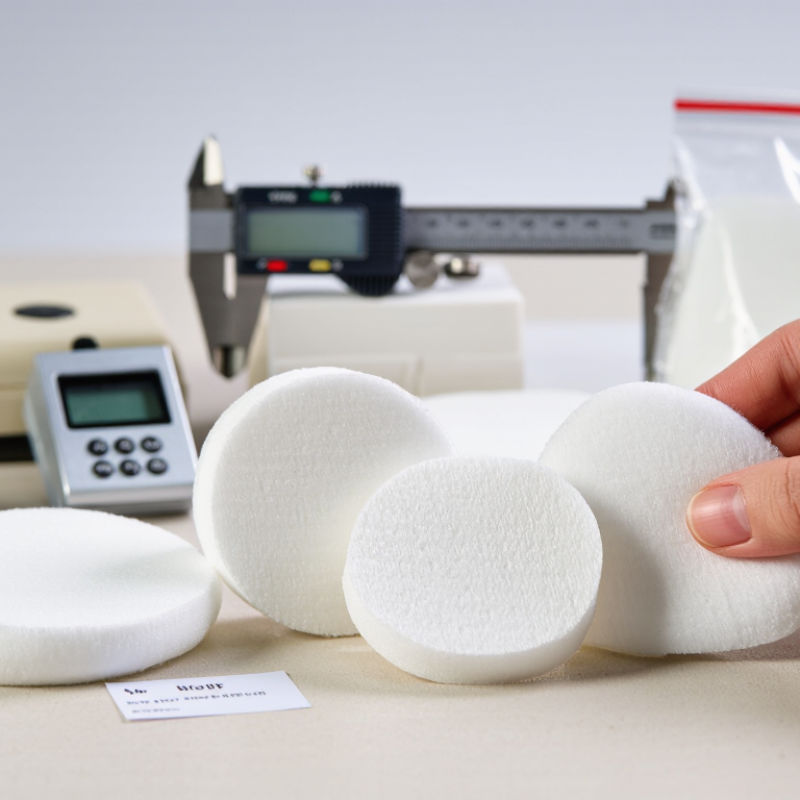
How to Find the Best China Monocell Powder Puff Supplier?
A reliable supplier should define Monocell puff specifications before discussing price. Cell size affects texture, edge control, and liquid release. Smaller cells usually feel smoother and distribute product evenly. Larger cells may absorb more, but they can waste liquid during application. Ask for measured cell size, not vague terms like “fine foam.”
Density influences firmness and handling. A dense puff may resist deformation, while a softer one feels gentler on the skin. Absorption should be tested with a fixed liquid volume and timed weighing. Rebound also matters. Press the puff repeatedly and record its recovery time. Fast rebound supports repeated use, although excessive rebound can feel springy. Test results can vary between batches. That detail is easy to overlook.
Tips: Request three production samples. Measure thickness, weight, density, absorption, and rebound under identical conditions. Keep photos and test records. Ask how the supplier controls raw materials, curing time, and final inspection. A clean sample can still hide inconsistent batch performance. Do not approve large quantities from one attractive sample. I would also check odor after sealed storage, because this small test often reveals overlooked process issues. Supplier answers should be specific, documented, and easy to verify.
A reliable supplier should show more than attractive product photos. Ask for the ISO 9001 certificate, issuing body, validity period, and covered factory address. The ISO Survey 2022 recorded 1,265,216 ISO 9001 certificates worldwide. This scale shows broad adoption, not automatic product quality. Check whether the certificate covers manufacturing and quality control, rather than only trading activities.
ISO 22716 is especially relevant for powder puffs touching cosmetic products. It addresses hygiene, personnel training, production controls, storage, complaints, and traceability. Request the supplier’s hygiene procedures, batch records, cleaning schedules, and material declarations. Walk through the facility if possible. Look for covered worktables, sealed packaging, handwashing controls, and separate areas for incoming materials and finished goods. Small details matter.
Ask for recent internal-audit records and corrective-action reports. A supplier with no recorded problems may simply have weak reporting. That deserves reflection. Also request test data for shedding, odor, colorfastness, compression recovery, and skin-contact materials. Independent laboratory reports are stronger than factory-only statements. Verify sample consistency across several production batches. One perfect sample proves little. For every document, confirm its reference number directly with the certification body. ISO 9001 manages quality processes, while ISO 22716 supports cosmetic-product hygiene practices. Neither standard replaces your own inspection, sampling plan, or risk assessment.
How to Find the Best China Monocell Powder Puff Supplier?
A reliable supplier should prove material safety, not merely promise it. Ask for current REACH and RoHS test reports before discussing large orders. These documents should identify the tested material, laboratory, report date, and applicable test methods. Check that the report matches the actual monocell powder puff, not a similar product.
Look closely at batch safety test reports. The lot number on the report should match the production batch marked on cartons or sample packaging. Request records for odor, color stability, harmful substances, and skin-contact safety. A professional supplier can explain sampling quantities and testing frequency in clear language. Vague answers are warning signs.
Request a pre-production sample.
Compare its softness, rebound, surface texture, and smell with the approved sample. I once treated a laboratory report as enough proof, but the delivered puff felt firmer than expected. That mistake showed me why document checks and physical inspections must work together. Ask whether testing covers raw materials, adhesives, dyes, and packaging contact surfaces. Keep signed specifications, sample photos, and inspection results in one file. Reports can be genuine yet incomplete, especially when they cover only one material layer. A careful supplier will accept reasonable verification and update records when formulations or factories change.
| Verification Dimension | What to Verify | Applicable Requirement or Reference | Required Evidence | Acceptance Criteria | Risk Level |
|---|---|---|---|---|---|
| Product Construction | Confirm whether the puff uses single-cell or open-cell foam, plus the surface coating, flocking, adhesive, elastic band, and packaging materials. | Supplier material declaration and approved product specification. | Signed bill of materials, technical drawing, and material safety data where applicable. | All material layers and changes are documented before mass production. | High |
| REACH Compliance | Screen the finished puff and all accessible components for substances restricted under REACH, including SVHC reporting obligations. | EU REACH Regulation (EC) No. 1907/2006; SVHC Candidate List requirements. | Recent third-party REACH test report identifying the tested sample, material layers, test methods, and report date. | No restricted substance exceeds the applicable legal limit; SVHC information is disclosed when legally required. | Critical |
| RoHS Screening | Determine whether the finished article or any electrical accessory falls within the scope of RoHS. If not applicable, document the justification. | EU RoHS Directive 2011/65/EU and amendment Directive (EU) 2015/863. | RoHS report or written scope assessment covering lead, mercury, cadmium, hexavalent chromium, PBB, PBDE, and the four phthalates. | Applicable restricted substances comply with the directive limits; non-applicability is supported by a documented product assessment. | High |
| Heavy Metals | Check pigments, printed areas, metal accessories, coatings, and any colored surface for lead, cadmium, mercury, and chromium compounds. | Applicable REACH restrictions, RoHS limits where applicable, and the laboratory's validated test method. | Laboratory report with sample photographs, digestion method, detection limits, and individual results. | Every tested material layer passes the applicable limit; “pass” without numerical results is not sufficient. | High |
| Formaldehyde and VOCs | Evaluate formaldehyde and volatile emissions from foam, adhesives, coatings, and printed materials that may contact skin. | Use a validated laboratory method, such as ISO 14184-1 for formaldehyde in textile-related materials when technically suitable. | Test report stating the method, sample conditioning, detection limit, and result in mg/kg or the applicable unit. | Result meets the destination market's legal or customer specification; the method must match the material tested. | Medium |
| Skin-Contact Safety | Assess irritation, sensitization, odor, dye transfer, and loose fibers because the puff is intended for repeated facial contact. | Destination-market cosmetic accessory requirements and buyer-approved skin-contact specifications. | Material safety declaration, colorfastness results, odor assessment, and applicable biological or irritation evaluation. | No abnormal odor, visible shedding, unacceptable color transfer, or safety result outside the approved specification. | Critical |
| Microbiological Quality | Test the finished puff for total aerobic microbial count, total yeast and mold count, and specified pathogens when required by the product risk assessment. | Buyer specification and applicable cosmetic microbiological guidance for non-sterile accessories. | Batch-specific microbiological report showing sampling date, production lot, test method, and quantitative results. | Results comply with the approved specification, with no specified pathogen detected when such testing is required. | Critical |
| Batch Traceability | Match raw-material lots, production dates, operators, inspection records, packaging lots, and shipment quantities. | Documented quality-management and traceability procedure. | Lot code, production record, incoming-material inspection, in-process inspection, and final inspection records. | One-step-back and one-step-forward traceability is available for every shipped lot. | High |
| Batch Sampling Plan | Confirm how samples are selected for appearance, dimensions, function, and laboratory testing. | ISO 2859-1 may be used for attribute inspection when an appropriate inspection level and AQL are agreed. | Approved inspection plan stating lot size, sample size, inspection level, AQL, and critical-major-minor defect rules. | Sampling plan is approved before production and applied consistently to each shipment. | High |
| Physical Performance | Verify dimensions, thickness, density, compression recovery, surface uniformity, seam strength, elastic-band attachment, and shedding. | Approved technical specification and golden sample. | Pre-production sample approval, dimensional report, functional inspection, and retained reference sample. | All measurements and functional results remain within agreed tolerances; no critical defects are permitted. | Medium |
| Laboratory Independence | Check whether the testing laboratory is competent, identifiable, and independent from the production process. | ISO/IEC 17025 accreditation is preferred for applicable laboratory activities. | Complete report with laboratory address, accreditation scope, report number, authorized signature, and sample identification. | Report is authenticatable, within its validity period, and covers the exact material or finished product supplied. | High |
| Change Control | Require notification before changing foam formulation, flocking, adhesive, dye, production site, or subcontractor. | Contractual quality agreement and supplier change-control procedure. | Written change-notification process, revised bill of materials, risk assessment, and re-testing plan. | No material or process change is implemented without written approval and risk-based requalification. | High |
Compare MOQ, Sample Lead Time, Production Capacity, and 30-Day Delivery
A reliable supplier should explain its MOQ clearly. Ask whether the quantity includes one color, size, and packaging style. A 500-piece MOQ may seem attractive, but mixed specifications can increase the real order volume. Request a written quotation with material, dimensions, logo method, and packing details. Small details matter.
Sample lead time reveals production discipline. For a monocell powder puff, a practical sample window is often three to seven working days. Ask for the sample tracking number and inspection photos. Check softness, rebound, edge trimming, and powder release. The first sample may not be perfect. That is useful feedback, not a failure.
Production capacity must match the promised 30-day delivery. Ask for monthly output, current factory loading, and the daily capacity for your exact design. A supplier may produce 100,000 pieces monthly, but custom packaging can slow dispatch. Request a production schedule with cutting, molding, inspection, packing, and shipment dates. Do not accept “ready soon.” Confirm the buffer for rejected pieces and transport delays. In my experience, a seven-day reserve makes delivery planning safer. Still, capacity claims need evidence. Recent inspection records, factory videos, and a small trial order provide stronger proof than polished sales messages.
How to Find the Best China Monocell Powder Puff Supplier?
Audit Production Quality with AQL 1.5/2.5 and Three-Sigma QC Records
A dependable supplier should provide more than polished samples. Ask for batch records, inspection photos, and measurable production data. For monocell powder puffs, check pore uniformity, thickness, rebound, edge cutting, and surface softness. During a factory audit, compare fresh samples with archived pieces from the same batch. An AQL 1.5 plan can control major defects, while AQL 2.5 may apply to minor defects. Confirm these limits before production begins. AQL does not mean zero defects.
Tips: Request the sampling plan in writing. Verify inspector training and gauge calibration dates. Review three-sigma records for thickness, density, compression recovery, and appearance. The data should show averages, limits, sample sizes, and corrective actions. Missing values deserve questions.
Reliable records should connect raw material lots to packing cartons. This traceability helps identify problems quickly. Watch the line, not only the showroom. A clean cutting table, covered materials, and separated rejected pieces reveal daily discipline. Still, one audit cannot prove everything. I would repeat checks across several batches, because supplier performance can drift. A beautiful sample may hide inconsistent production. Honest factories explain weak results and show how they improve them.
Sampling reference for a lot of 1,201–3,200 units under ISO 2859-1 General Inspection Level II: code letter K requires a sample of 125 units. The three-sigma value is calculated from an assumed process average defect rate of 2.0%: UCL = p̄ + 3√[p̄(1−p̄)/n] = 5.76%, or approximately 8 units.
AQL 1.5 and AQL 2.5 are sampling-quality reference levels, not direct process defect-rate targets. For a sample of 125 units, the corresponding acceptance and rejection numbers are shown for audit decision-making. Any result above the rejection number should trigger investigation and corrective action.
Request current REACH and RoHS test reports. Each report should identify the material, laboratory, date, and test methods. The tested material must match the actual powder puff. A similar product is not enough.
Match the report’s lot number with the cartons or sample packaging. Ask for odor, color stability, harmful-substance, and skin-contact results. Review the sampling quantity and testing frequency. Vague answers need closer attention.
Documents cannot show every physical detail. Compare softness, rebound, surface texture, edge trimming, and smell. Place the approved sample beside the new sample. The difference may be obvious.
Testing should cover raw materials, adhesives, dyes, and packaging contact surfaces. A report may cover only one material layer. Keep specifications, photos, and inspection results together. I once trusted a report too much.
Confirm whether the minimum includes one color, size, and packaging style. A 500-piece minimum may change with mixed specifications. Request written details for materials, dimensions, logos, and packing. Small details matter.
Three to seven working days is often practical. Request tracking information and inspection photos. Check powder release and rebound after arrival. The first sample may need changes.
Ask for monthly output and capacity for your exact design. Review cutting, molding, inspection, packing, and shipment dates. Custom packaging may slow dispatch. Keep a seven-day buffer when possible.
AQL 1.5 may control major defects, while AQL 2.5 may cover minor defects. Confirm the limits before production. Three-sigma records should show averages, limits, sample sizes, and corrective actions. AQL does not mean zero defects.
Watch the production line, not only the showroom. Look for covered materials, clean cutting tables, and separated rejected pieces. Check pore uniformity, thickness, density, and rebound. One audit cannot prove consistent performance.
Connect raw-material lots with inspection records and packing cartons. Review inspector training and gauge calibration dates. Repeat checks across several batches. Supplier performance can drift.
Finding the best Monocell Powder Puff supplier in China requires a clear evaluation process rather than relying on price alone. Start by defining the product specifications, including cell size, material density, liquid absorption, softness, and rebound performance. These factors directly influence application control, comfort, durability, and suitability for different cosmetic formulas. Suppliers should also demonstrate structured quality management through ISO 9001 and, where applicable, ISO 22716 systems.
Before placing an order, verify raw materials and request REACH, RoHS, and batch-specific safety test reports. Compare minimum order quantities, sample lead times, production capacity, and the supplier’s ability to meet a 30-day delivery target. A factory audit should review incoming-material checks, in-process inspections, final sampling, and AQL 1.5/2.5 standards. Three-sigma quality records can further reveal process stability and consistency. By combining technical specifications, documentation, logistics capability, and production audits, buyers can select a reliable supplier and reduce quality, delivery, and compliance risks.